

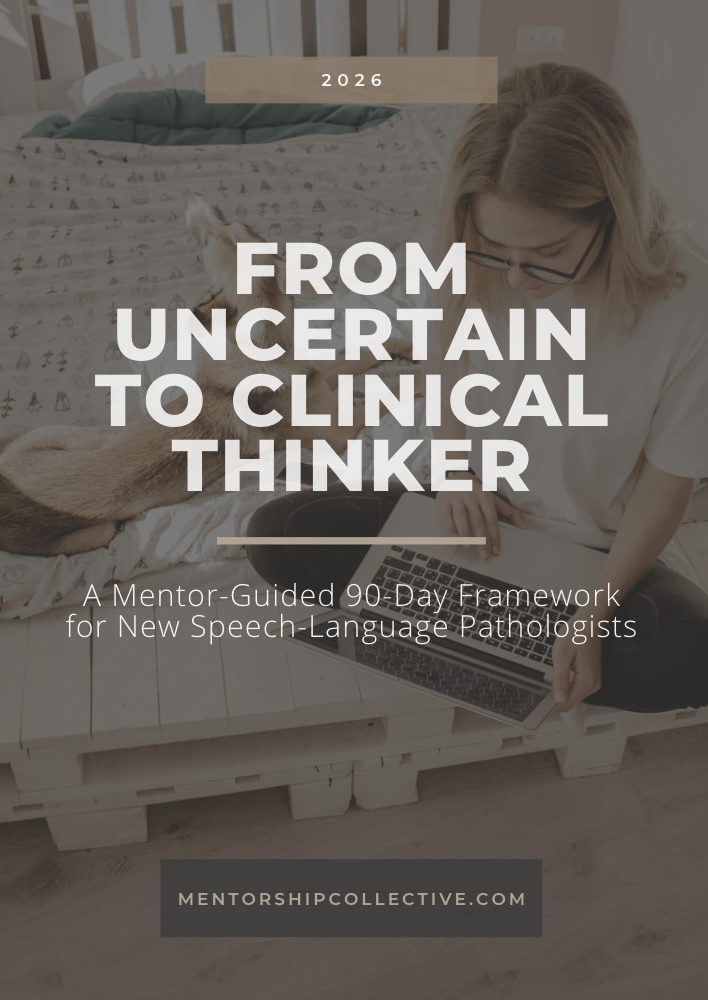
From Uncertain to Clinical Thinker™
A Mentor-Guided 90-Day Framework for New Speech-Language Pathologists
Grad school taught you the knowledge.
This framework helps you learn how to think like a clinician.
Your first months in practice can feel overwhelming. You are making decisions independently, adjusting therapy in real time, and learning how to trust your clinical judgment.
This workbook was designed to support you through that transition—with structure, clarity, and mentorship-guided reflection.
You do not need to have everything figured out.
You need a framework that helps you grow.
Get Instant Access — $27 Digital Workbook
Order Printed Workbook — $47

Best Sellers

Printed Workbook — $47
• Professionally printed and bound
• Designed for daily use and reflection
• Shipped directly to you
Shipping not included in price.
Digital Workbook— $27
• Instant download
• Printable PDF format
• Accessible immediately after purchase
• Use on tablet, computer, or print at home

Bundle — $65
Instant digital download (From Clinician to Mentor Workbook PDF)
2- hour On-Demand PDH Mentor/Supervision Training
Clinical Thinking Development
❋
Structured Mentorship
❋
Confidence Through Reflection
❋
Supporting New Speech-Language Pathologists
❋
Designed for Real-World Practice
❋
Clinical Thinking Development ❋ Structured Mentorship ❋ Confidence Through Reflection ❋ Supporting New Speech-Language Pathologists ❋ Designed for Real-World Practice ❋
This Workbook Helps You Develop What Grad School Couldn’t Fully Teach
Graduate training provides essential knowledge. Clinical confidence develops through experience, reflection, and support.
From Uncertain to Clinical Thinker™ provides structured guidance to help you:
• Build clinical reasoning and decision-making skills
• Strengthen documentation clarity and professional language
• Learn how to adjust therapy when sessions don’t go as planned
• Develop confidence through structured reflection
• Ask more effective, clinically grounded questions in supervision
• Recognize patterns in client performance and adjust intentionally
This is not about becoming perfect.
It is about learning how to think clearly, reflect effectively, and grow with intention.
Frequently Asked Questions

-
This workbook provides a structured framework to help you develop clinical reasoning, confidence, and professional clarity during your first 90 days of practice.
You’ll learn how to:
• Reflect on therapy sessions in a productive, growth-oriented way
• Recognize patterns in client performance and adjust your approach intentionally
• Strengthen your documentation using clear, ethical, and professional language
• Ask more effective questions in supervision and mentorship
• Build trust in your clinical judgment and decision-makingThe goal is not perfection—it’s helping you develop the thinking skills that support your entire clinical career.
-
Clinical reasoning develops through structured reflection, observation, and intentional adjustment—not just experience alone.
This workbook provides guided reflection tools that help you:
• Analyze what happened in your sessions
• Identify what influenced client performance
• Recognize patterns across sessions
• Make thoughtful, informed therapy decisionsOver time, this process helps you move from uncertainty toward confidence and independence.
-
Yes. One of the core focuses of this workbook is helping you develop confidence and clarity in your documentation.
You’ll learn how to:
• Describe client performance clearly and professionally
• Balance strengths and challenges in your documentation
• Use language that reflects clinical accuracy and ethical practice
• Understand what documentation communicates to families, teams, and payersThis helps you feel more confident in both your writing and your clinical reasoning.
-
No. This workbook is helpful for:
• Clinical Fellows (CFs)
• Newly graduated Speech-Language Pathologists
• SLPs in their first 1–2 years of practice
• Clinicians transitioning into a new clinical setting
• Clinics onboarding new cliniciansAny clinician in the early stages of developing independence and confidence will benefit from this framework.
-
This workbook is designed to be used either independently or alongside mentorship and supervision.
It provides structured tools that help you reflect, organize your thinking, and prepare for conversations with supervisors or mentors. Many clinicians find it helps them ask clearer, more clinically grounded questions.
It complements mentorship—it does not replace it.
-
This is not a therapy activity workbook.
It is a clinical thinking framework designed to help you develop the skills behind effective therapy, including:
• Clinical reasoning
• Decision-making
• Reflection
• Documentation clarity
• Professional confidenceThese are foundational skills that support your growth across all therapy settings and client populations.
-
Yes. This workbook was created based on real mentorship experience and reflects the actual challenges new clinicians face, including:
• Uncertainty during therapy sessions
• Documentation challenges
• Clinical decision-making
• Confidence development
• Mentorship conversations
• Professional and emotional growthIt acknowledges the reality of early clinical practice and provides tools that help you navigate it effectively.
-
The workbook is designed as a 90-day framework, but you can complete it at your own pace.
You may choose to:
• Use it consistently over your first three months
• Complete sections as specific challenges arise
• Revisit sections as your experience growsMany clinicians continue using it beyond the initial 90 days as their confidence develops.
-
You can choose the format that works best for you:
Digital Workbook — $25
• Instant download
• Printable PDF
• Accessible immediately
• Use on tablet, computer, or print at homePrinted Workbook — $37
• Professionally printed and bound
• Designed for daily reflection and use
• Shipped directly to youBundle — $45
• Printed workbook
• Instant digital access -
This workbook was created by The Mentorship Collective™, founded by Speech-Language Pathologists dedicated to supporting clinicians through structured mentorship and professional development.
It reflects real clinical mentorship experience and the developmental process clinicians move through as they build confidence, independence, and professional identity.
-
Yes. Many clinics use this workbook as part of their clinician onboarding process to support the development of:
• Clinical reasoning
• Documentation confidence
• Professional independence
• Mentorship communicationClinic licensing options are available for teams onboarding new clinicians.
-
Confidence develops through structured reflection, experience, and support.
This workbook provides the framework to help you:
• Understand your growth
• Organize your clinical thinking
• Recognize your progress
• Develop trust in your decision-makingYou do not need to feel confident to begin. Confidence develops as you continue to learn, reflect, and grow.
The Mentorship Collective™
Structured mentorship. Sustainable clinicians.